b.
Loading Content

Here's a simpler, more engaging version:
Imagine you need to send an important message to everyone in your company.
What would happen?
In many mid-sized and large companies, the process is harder than it should be.
Someone exports an employee list from HR.
Another person uploads it to an email tool that was not designed for internal communication. Some emails fail because the list is outdated.
In the end, no one really knows how many employees opened or read the message.
This is a common problem. Companies invest in advanced tools for marketing emails with smart targeting, automation, and detailed reports. But internal communication is often managed with outdated tools and spreadsheets.
When a company has 20 people, an all-hands email is simple. Everyone is on one list, most people read it, and if something goes wrong you can just ask around.
When a company has 2 thousand people, the same email touches many departments, different time zones, and people who do not need every update. Send everything to everyone and people stop paying attention. Send too little and rumors fill the empty space.

Most companies never built a proper system for this. They simply borrowed marketing tools because those were the tools that already existed. A system designed to sell products to strangers works very differently from a system that should talk to your own workforce.
Here is a question worth thinking about: When your company sends an internal announcement through a regular public email service, where does that information actually go?
Employee names, job titles, department details, and even who opened the message often pass through servers you do not control. For a simple retail newsletter this may not matter much. For a bank sending compliance updates, a hospital coordinating with staff, or a government office sharing internal directions, it is a real risk.
Public email tools were built for high-volume promotional messages. They were not built to protect the internal structure of an organization. As companies grow, the mismatch becomes more expensive and risky.
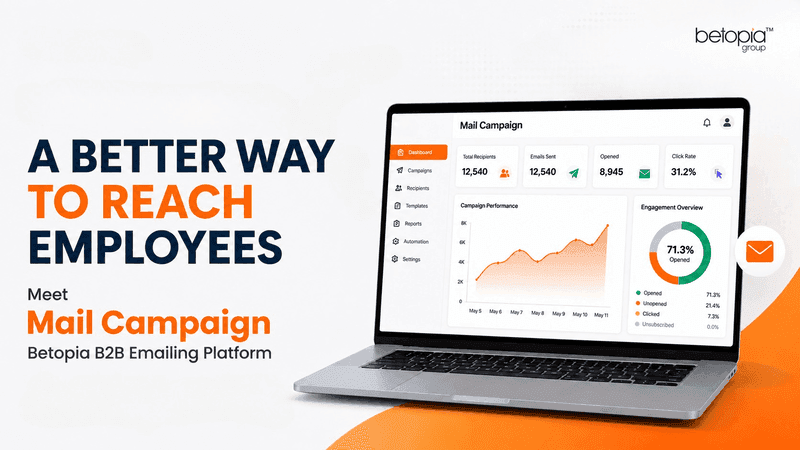
This is exactly the gap Betopia’s B2B Emailing Platform was created to close. The system can be hosted privately inside your own environment. Your communication stays inside your walls. No public exposure. No renting access to your own company structure.

A good internal email system should match the way a real company works.
You should be able to send a message only to the finance team. A message for senior leaders should be handled differently from a cafeteria menu update. Betopia's platform makes this easy with organization mapping. You can send messages based on department, seniority, or business unit.
Speed is also important. Sometimes leaders need to reach 10,000 employees right away. The system should deliver messages quickly. Betopia's one-click emailing feature is built for these moments.
AI is now included in many business tools, but it often does not provide real value.
| Area | The Problem | How AI Helps | What Stays Human |
| Company-wide emails | The wrong tone can confuse employees, and long or formal messages often get ignored | Checks tone and clarity before the message go es out | The writer decides what to say, and when |
| Employee replies | Thousands of employees often ask the same few questions | Summarizes common questions and routes them to the right team | The team decides how to respond |
Many companies send important internal emails but never know if people actually read them. Sending a message is only the first step. What really matters is whether employees opened it and understood it.
A good platform gives you real-time analytics. You can see delivery status, open rates, and engagement by department. Instead of saying, "We sent the email," you can say, "78% of the operations team opened it within one hour." This helps leaders understand what is working and what needs improvement.
Before selecting a platform, ask these questions:
The answers will help you decide whether your current system still meets your organization's needs.
Internal communication is often overlooked until something goes wrong. A message may reach the wrong people, fail to reach employees, or expose information that should stay private. When that happens, the cost can be much higher than expected.
If your organization is still using tools that were not designed for secure internal communication, it may be time to consider a better solution.
Look for a platform that protects employee data, reflects your company structure, and clearly shows whether employees are engaging with your messages.
Betopia's private mail campaign platform is built for these needs. It keeps employee data inside your own environment, supports your real organizational structure. It delivers messages quickly at any scale, and provides clear insights into employee engagement.

Found this interesting? Share it with your network.
Join our global AI partnership network and build the future together.
Get Started